

Build the world. Evolve the story. Connect everything.
LorEvolve is a place to build a fictional world and write the stories that happen in it. Connect every aspect of your story in the platform. The alpha is opening for a small group of early testers, and I'd love your help shaping it, so that we may transform our ideas into reality.
Want to try it early?
The alpha is the first test of the application. Starting with a handful of people, so we can continue shaping the system. Expect rough edges and things that change. What helps most is honest feedback: what works, what doesn't, and what's missing.
Write it down once.
Most worlds outgrow the notebook and people are constantly having pain finding their own resources and how to connect the odds. This is struggle I had on my own to make my story.
In LorEvolve each fact is written once, and the rest of the world reads it from there.
I'm making it for whoever carries a world around in their head and would like it written down somewhere better: a series of novels, a game story, a comic, or a place you simply enjoy inventing.
AI is optional.
Every world has an AI help switch, and it starts off. With it off, there's no assistant and no AI MCP connection available. You can choose to enable after the universe is created.
As a reader, AI can read your lore to answer questions, like "has this character ever been to the capital?", from what you actually wrote.
As a creator it can also suggest changes, but it never makes them on their own. You can choose this to create content from an excel page, or a md file without manual intervention. Every suggestion waits on a review page where you see exactly what would change, and you can edit it, accept it or reject it.
What you can do with it
Open any part to see what it does and why it's there.
A universe
Everything inside one universe: its lore, its history and its stories.
-
Lore entries
A page for every character, place and item. Everything is generic and customizable.
Every character, place, faction or object gets a page: a picture cropped the way you want, an article, the other names it goes by, tags, and the details its type asks for. You choose the fields you want to display on them.
Make many entries at once with a Mass Create from a list of names, or create one on the spot while you link to it.
Look up the innkeeper from chapter two without scrolling through a hundred pages.
-
Your own types
Your world's structure, designed by you.
A new world starts empty. You decide what kinds of things it has and what each records: a character might have a birth year and a house, a ship a crew and a captain.
Types can sit inside other types, fields can be grouped in sections, choice fields hold your own lists, and groups such as Places collect several types. Or start from a ready-made set and change it. You can even create a field that uses a lore entity as a mandatory field.
The structure fits your world, instead of your world bending to someone else's template.
-
Canon, history and private notes
Nothing you write is lost.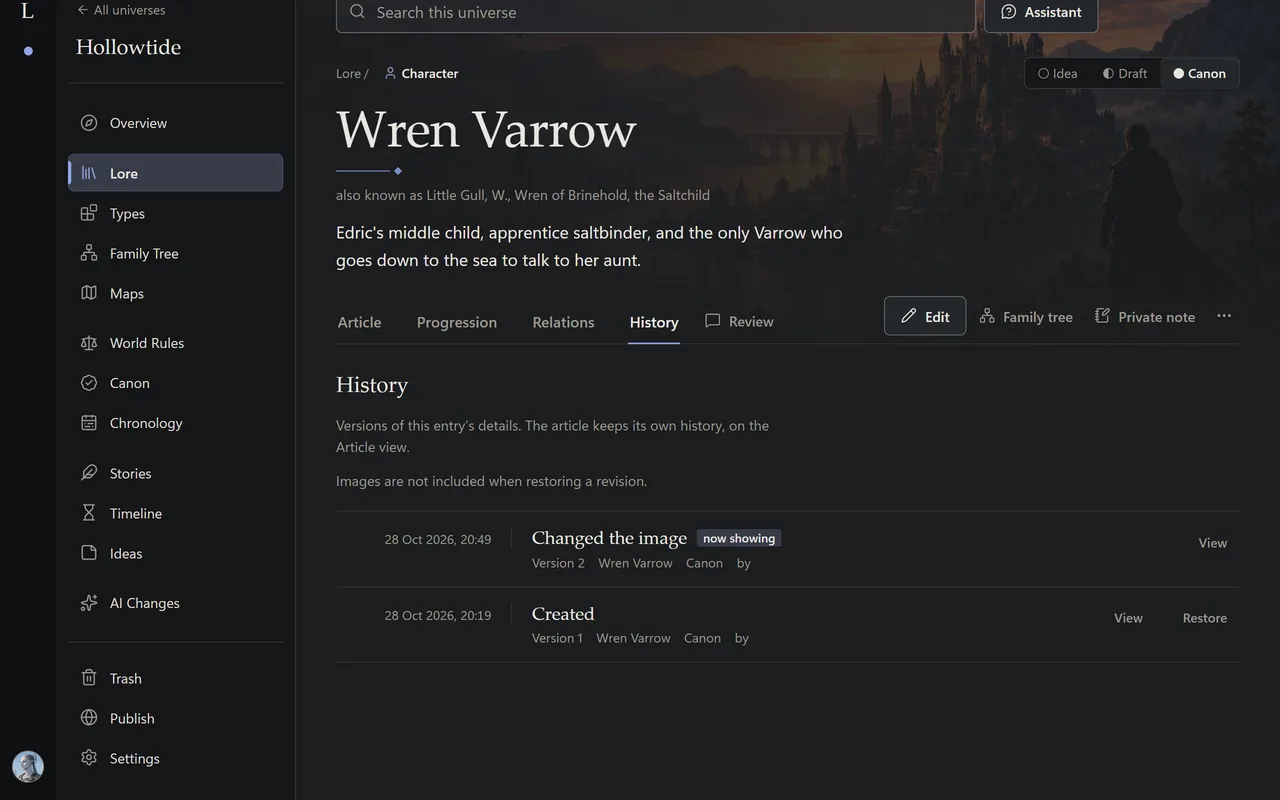
Mark each entry as an Idea, a Draft or Canon. Every save is kept as a version you can read and bring back, and anything you remove waits in the Trash before it is gone for good.
Each entry can carry a private note only you can see, never shown to collaborators, readers or an AI.
Try a big rewrite without worrying. The old version is one click away.
-
Relations
How things connect, and for how long.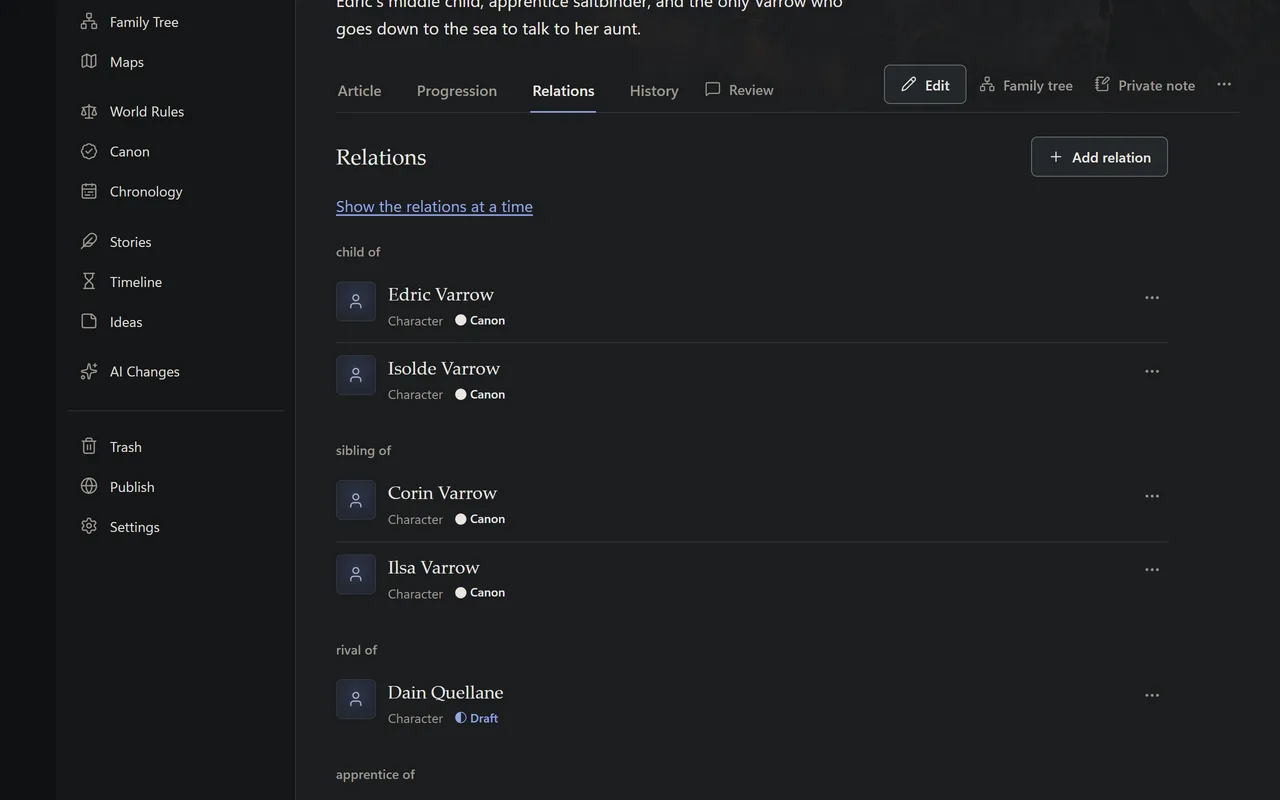
Invent your own kinds of relation, such as rules, sworn to or owes a debt to, read correctly from both ends. A relation can hold for a stretch of time, or for one stage of an entry's life, and leaving a faction and coming back is the same relation with two periods.
Your world's web of loyalties and feuds, kept straight.
-
Family trees
Record who's related. The tree draws itself.
Record parents and partners, and the tree works out the rest: siblings, aunts and uncles, cousins, nieces and nephews, across as many generations as you have. Other family you record, such as a guardian, shows as a labelled line.
Big families get confusing fast. The tree shows it at a glance and stays right as you change things.
-
Progression
How characters change over the story.
Give an entry stages, a character across arcs or a city across the years, each with its own picture and its own details. Add the forms it can take, what it can do, and how it looks, each with pictures.
You always know what a character was like at any point in the story.
-
Knowledge
Who knows what, and since when.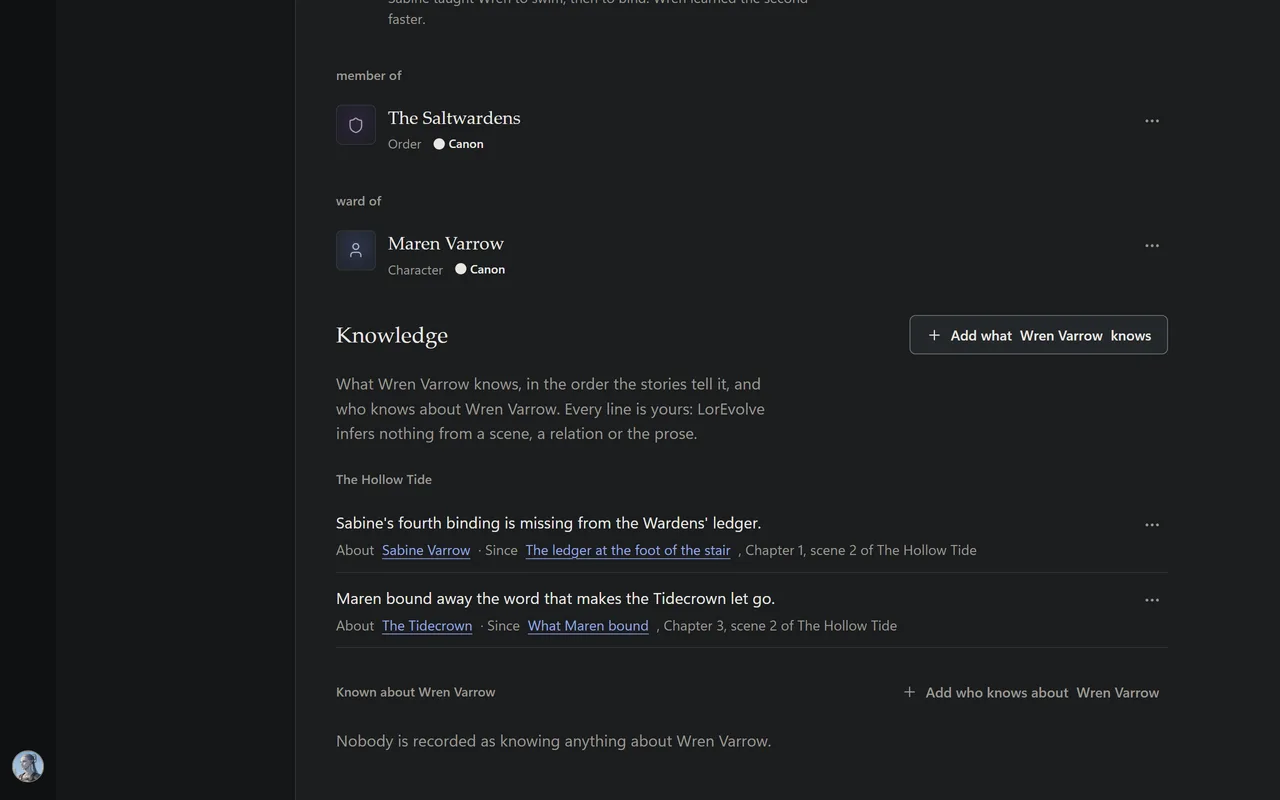
Record what a character knows, secretly or not, and from which scene, kept apart from what the lore says is true.
Mysteries and betrayals stay consistent: nobody acts on a secret before they learned it.
-
Maps
Your maps, with your lore pinned on them.
Upload your own maps and pin your lore onto them. Each pin opens its page, and a pinned page shows where it is. Give a map a scale in your own unit and measure distances on it. Draw interactive maps are being considered for a second phase.
You can see where things are and how far apart, without holding it all in your head.
-
World rules and canon checks
How your world works, checked for you.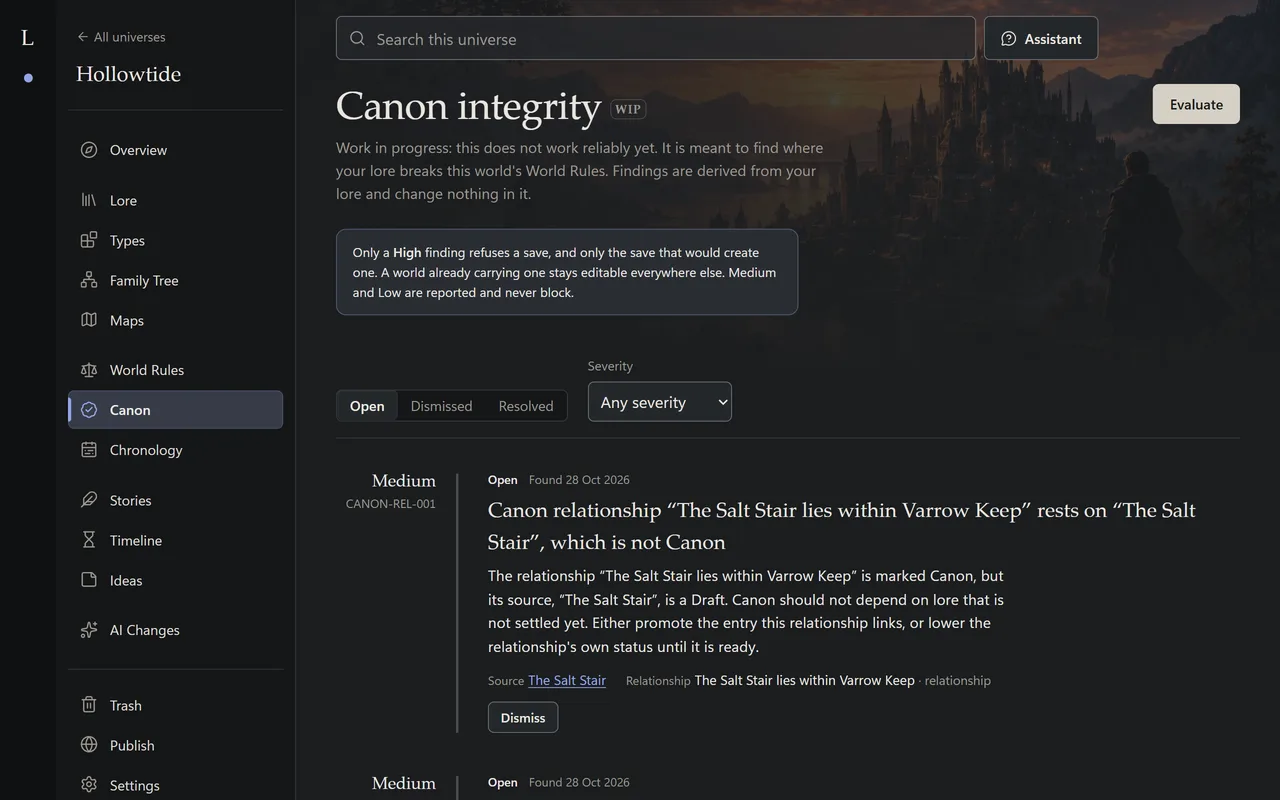
Write down how your world works, in your own words. A rule can carry a simple check, such as no one bound more than three times, that runs against your timeline.
LorEvolve also lists where your canon contradicts itself, such as a parent younger than their child. It never changes your lore; you fix it or dismiss it.
The goal is to detect plot holes you might have in the universe which is still a work in progress.
The mistakes readers would spot get spotted first, by you.
-
Your own calendar
Your world's own eras, months and dates.
Named eras that count up or down, your own months with their own lengths, and dates written the way they would be inside the story.
Dates read like your world, not squeezed into ours.
-
Stories and plot
Write the story inside the world.
Write in chapters and scenes, each with its own point of view and date. Type @ to mention a character or place and it becomes a link. Switch between writing and reading, and every saved version of a scene is kept.
Plan plot arcs and their beats, linked to the scenes they play out in and the lore they concern.
Not a writer at all? No problem, just skip the manuscripts.
The lore sits right next to the page, so checking a detail doesn't mean switching apps.
-
Timeline
Everything in order, in your world's own dates.
Add moments with who took part and which stories they matter to. Scenes set at a date appear on the same line by themselves.
You can see what happened when, across every story set in the world.
-
Comments and suggestions
Feedback right where it belongs.
Collaborators can comment on an entry, a story or a scene, and suggest a change you accept or reject, with what it was and what it would become side by side.
Feedback stays attached to the page it is about, not lost in a chat.
Your workspace
Around your worlds: ideas, people, your data and your tools.
-
Ideas
Room for what isn't settled yet.
Jot an idea down as a line of text, or spread a few out on a board and join the ones that belong together. An idea can sit in one universe or stay unattached until you know where it goes, and it can point at the entries, scenes or plot beats it is about.
Half-formed ideas get a home without cluttering the world you've already settled.
-
Collaboration
Invite the people you trust.
Invite people into a universe as Editor, Reviewer or Viewer. They see it, you keep it.
Co-writers and test readers in the same place as the work.
-
AI
Off by default. Claude, ChatGPT and others, on your terms.Switch on AI help for a universe and you get a chat assistant inside LorEvolve. As a Reader it searches and answers from your lore; as a Creator it can also propose changes, which wait for your approval.
It also provides a MCP, an open standard that lets an AI app use another app's data. Connect Claude or ChatGPT to one universe, so a writing assistant or a game engine works from the story you created instead of guessing, or bring a whole world in quickly, as proposals you review one by one.
Disconnect at any time. Leave AI help off and none of this exists in your world.
-
Backup, export and search
Take a copy whenever you like.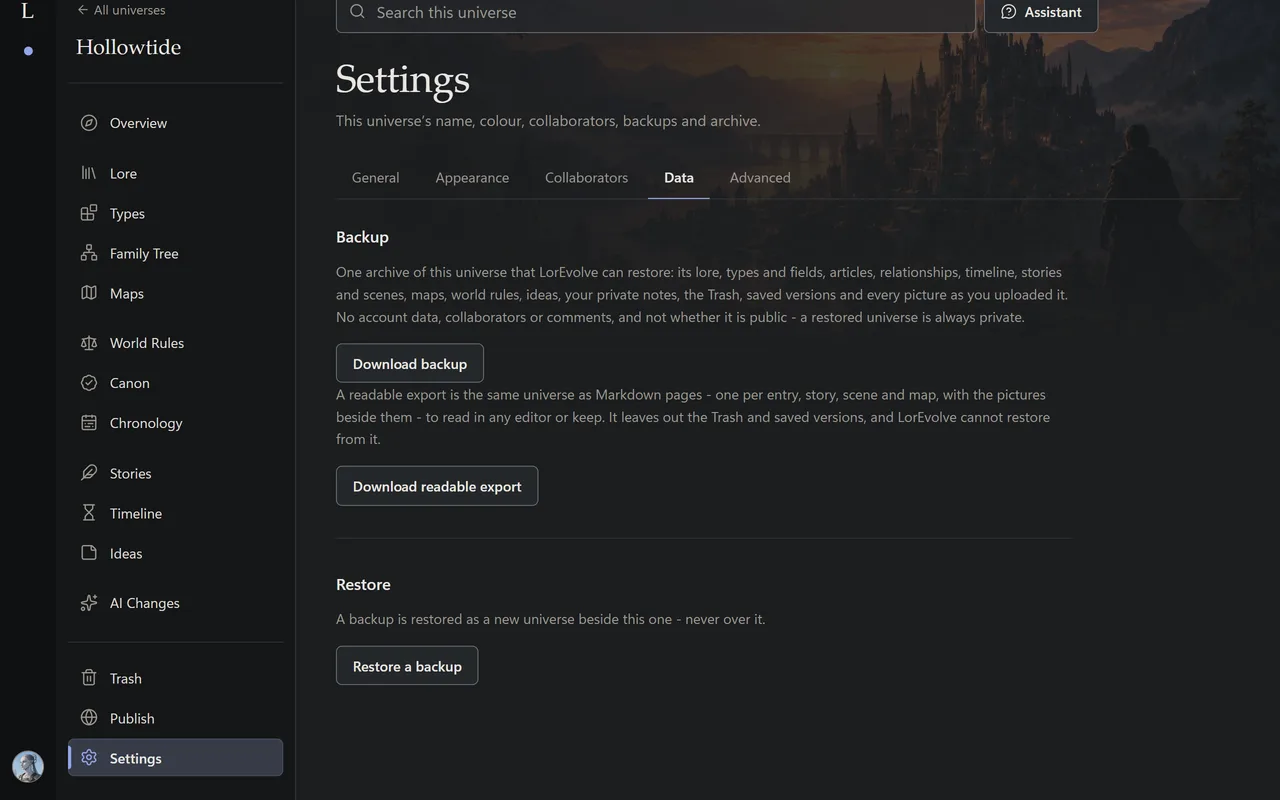
Download a full backup that LorEvolve can restore, or a readable export of Markdown pages with every original picture. Search across a universe's lore, stories and articles.
If you ever leave, your world comes with you, in a form you can still read.
-
An app on every screen
On your phone, tablet or computer.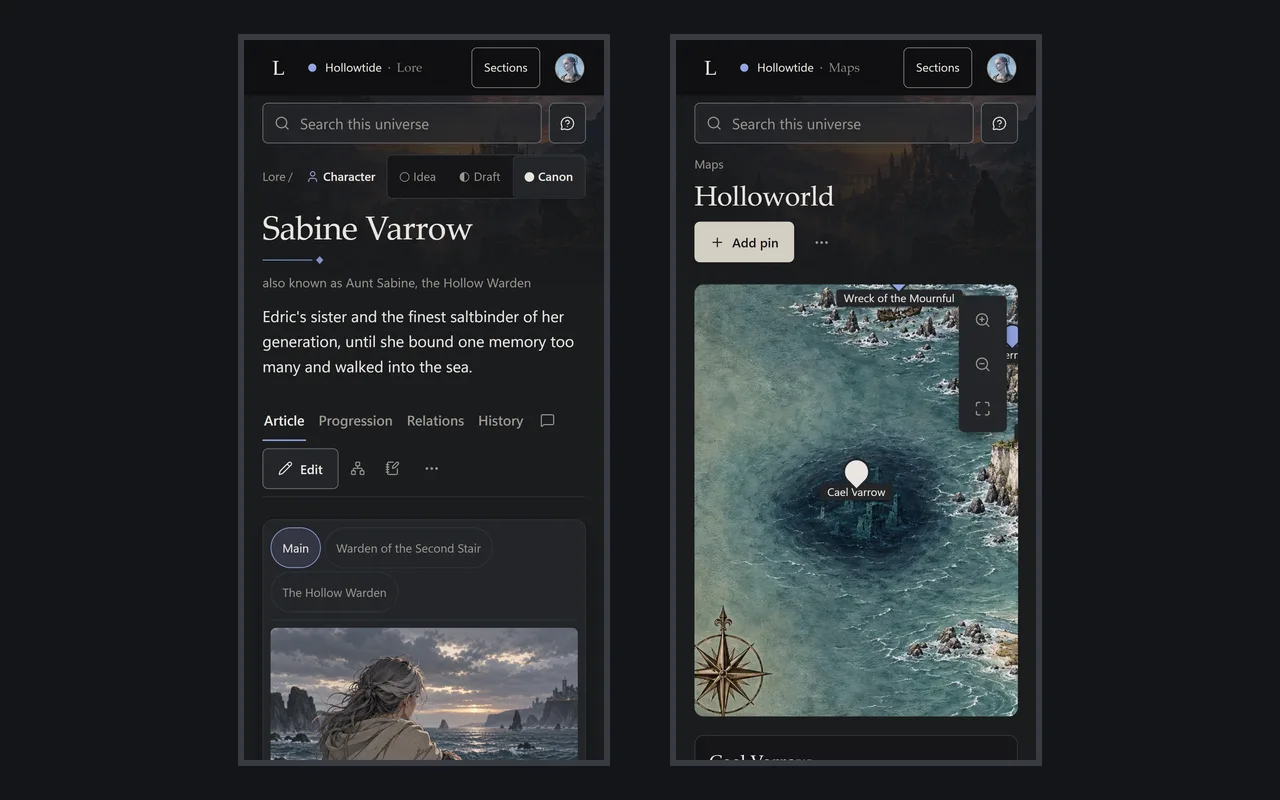
Install LorEvolve as an app on your phone or computer. It needs a connection; there is no offline mode. A Feedback button on every page sends a bug or a wish straight to me.
Check a name on your phone in the middle of a game session.
Public portal
If you're interested in publishing your story for other readers, you can publish it.
-
Publishing
Share the world, keep your notes.
Publish a universe piece by piece: you choose what is public, down to each entry, story and map. Everything else stays private.
Share your world with readers or players without handing over your notes.
-
Explore and author pages
Read other people's worlds.
Browse other authors' published universes, each author with a public page and a profile picture. Upvotes and downvotes are being considered.
Find readers, and find worlds worth reading.
Questions
Something missing? Ask on Discord or write to [email protected].
-
Will an AI touch my writing without my permission?
AI never changes anything on its own.
-
Is it free?
Yes, for the alpha. What comes after is still open, and the optional questions you get after applying feed straight into that choice.
-
Are there limits?
Each account has some limits for pictures and maps. Text has no set limit.
The built-in AI assistant chat shares one small allowance across everyone in the alpha, so for now it is very limited and may not answer at all. Connecting your own Claude or ChatGPT does not use that allowance.
-
Can I get my data out?
Yes. Export it as Markdown pages with all your original pictures, which open in any editor, or as a full backup that LorEvolve can restore.
-
Who can see my world?
Only you, and anyone you invite to work on it with you. Nothing is public until you publish it, and then only the pages and stories you pick.
-
Can I use it on my phone, or without internet?
It works in any browser, on a phone too, and you can install it like an app. It needs an internet connection; there's no offline mode.
-
How do I sign in?
With an email address and a password. Alpha accounts are opened by invitation.